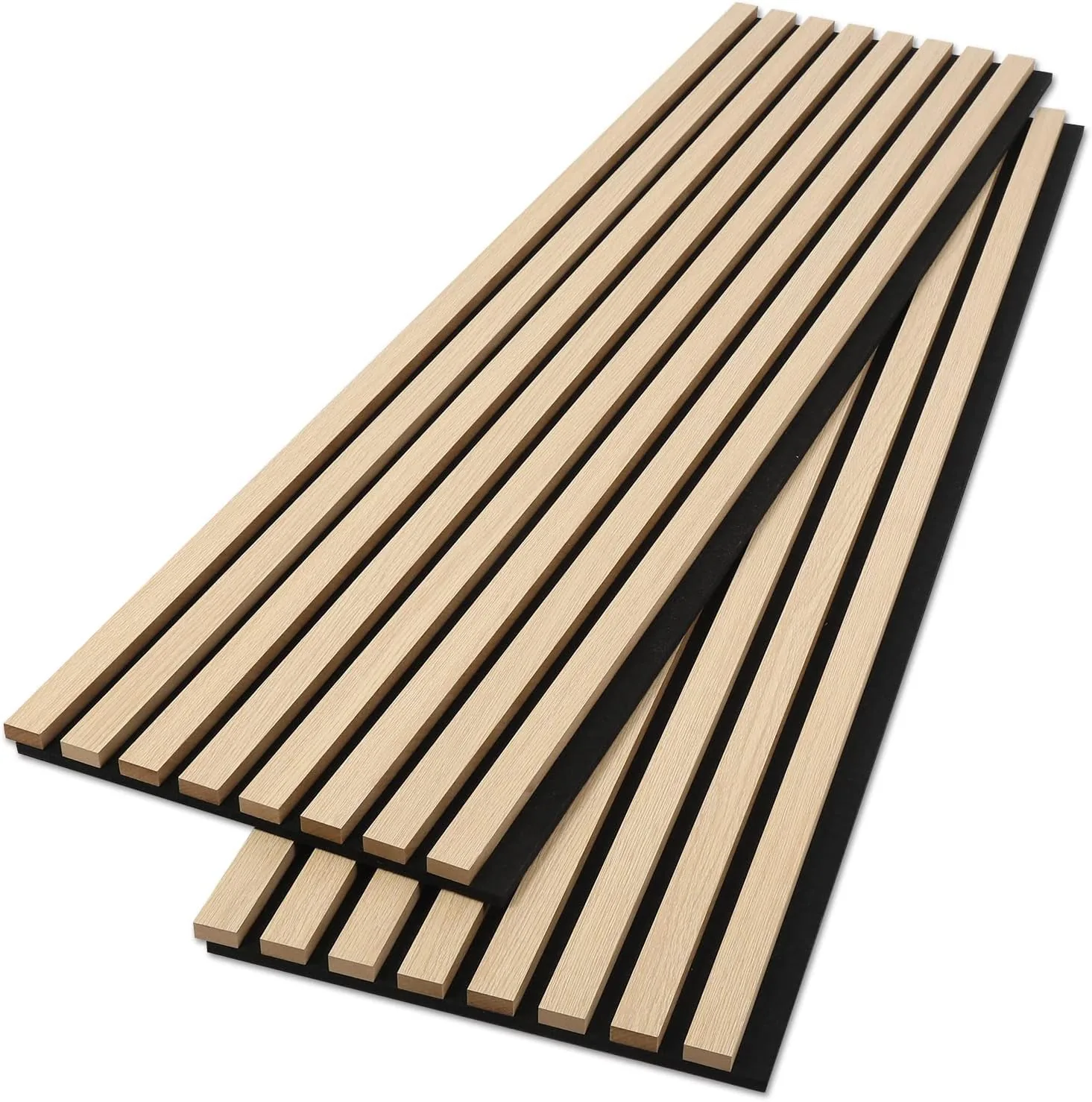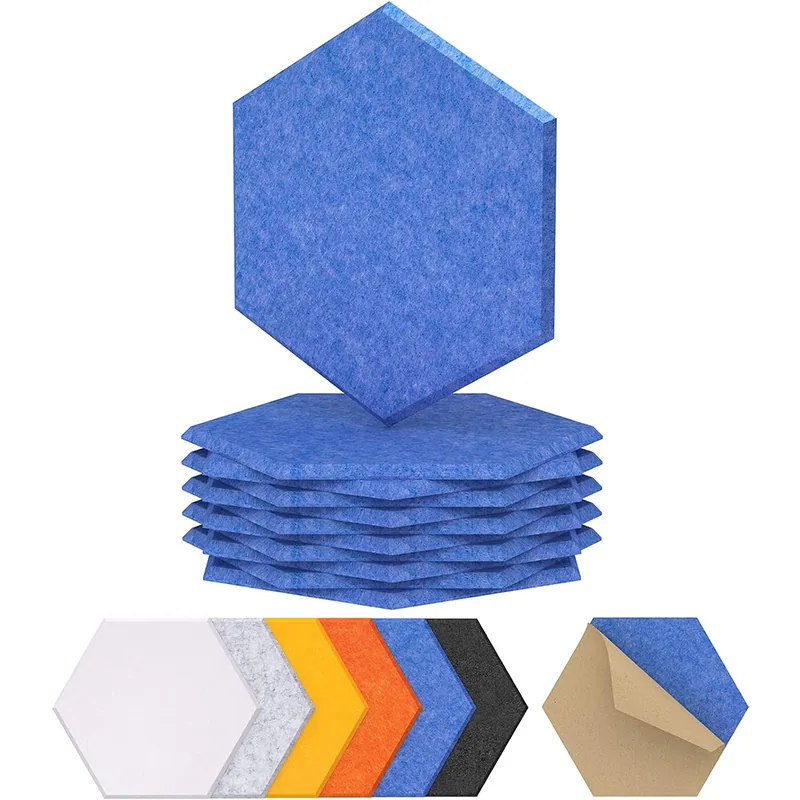
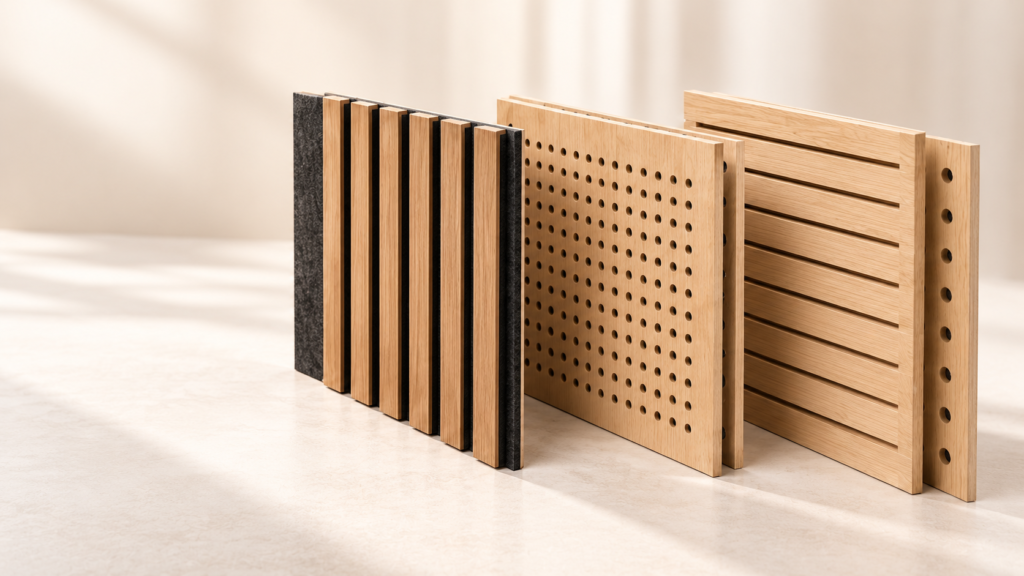
Three Common MDF Acoustic Panel Types
Slat MDF on PET Felt
Decorative MDF slats on PET felt, with an optional air cavity where specified. Confirm the backing and mounting configuration for the selected model.
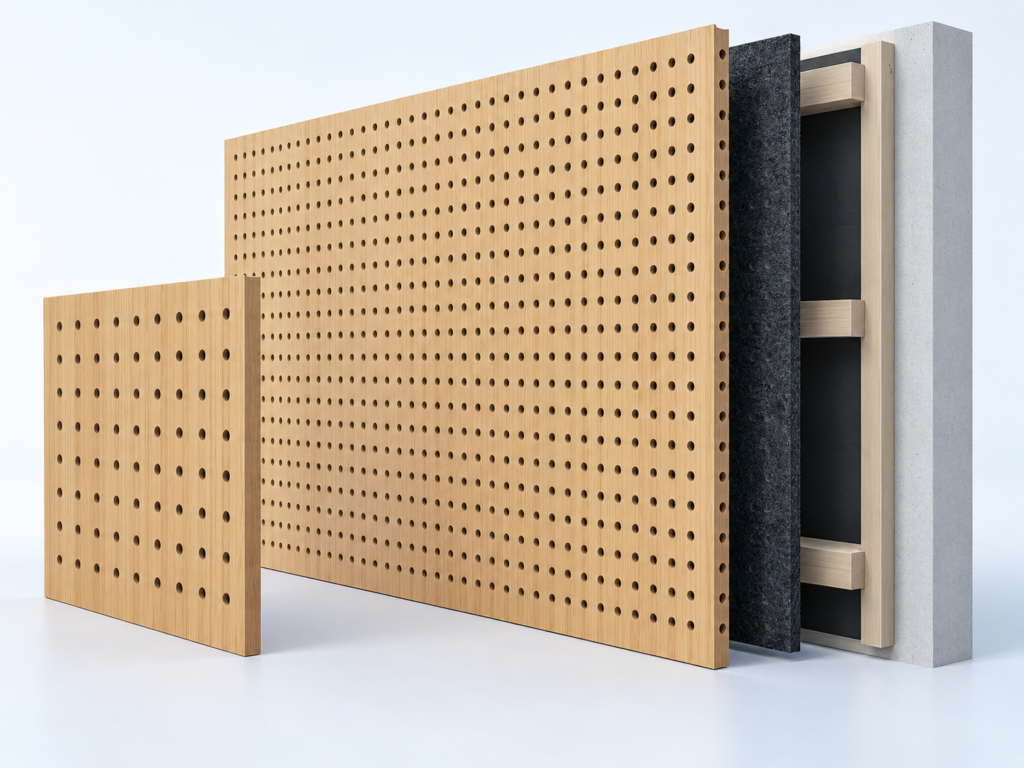
Perforated MDF Panel
Face perforations combined with acoustic fleece and a specified backing assembly. Hole pattern and mounting details are model-specific.
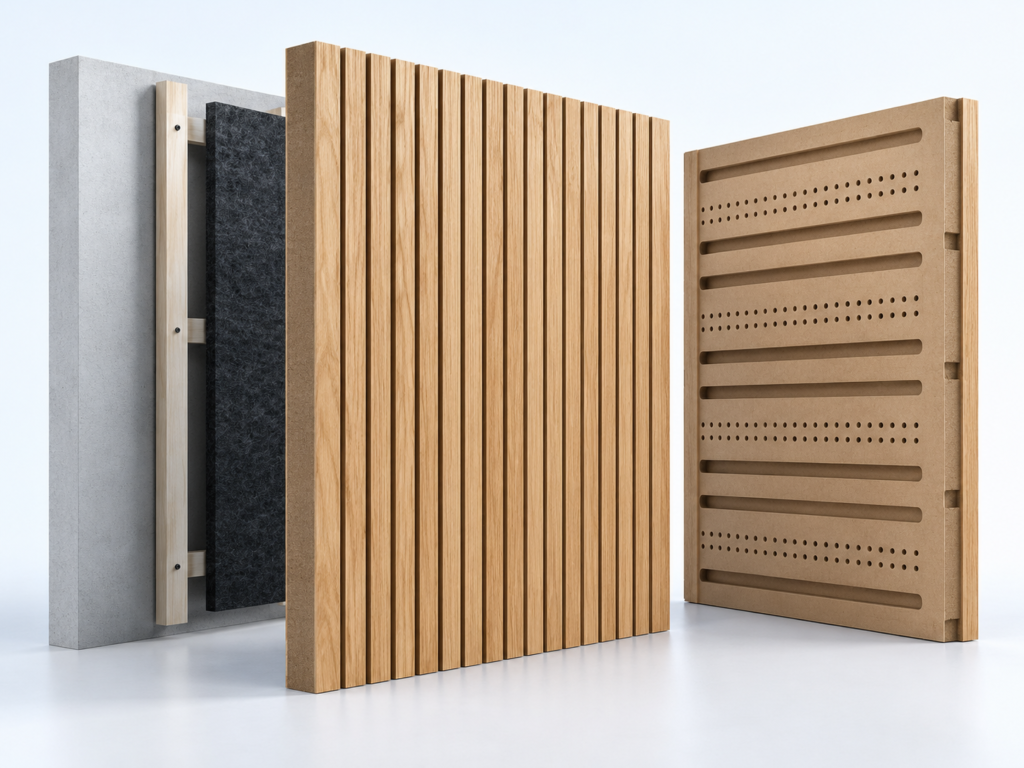
Grooved MDF Panel
Front grooves and rear slots or perforations form part of a designed acoustic assembly. Confirm the actual profile and backing in the product drawings.
Illustrative panel constructions; confirm the actual profile, backing and mounting arrangement for the selected product.
Introduction
This guide compares MDF-based acoustic panel types for interior applications. Consider the panel face, backing, cavity and fixing arrangement together when selecting a system. Acoustic results apply to the complete tested assembly, not to MDF alone.
What Is MDF in Acoustic Panels?
MDF stands for Medium Density Fiberboard. In these products it forms the panel core or decorative slats and can be machined with perforations or grooves. It is not a load-bearing building component. Performance and suitability must be confirmed for the selected panel and installation assembly.
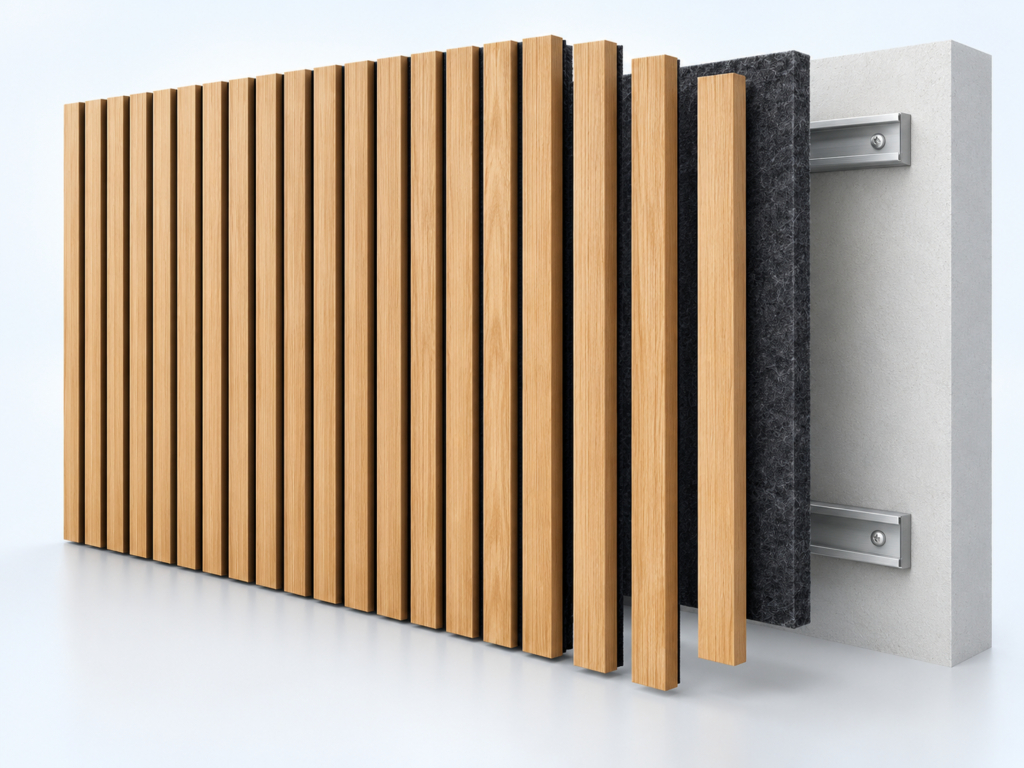
How MDF Acoustic Panel Systems Are Built
Conceptual layer sequences, not product cross-sections or installation drawings. Layer thicknesses, connections and backing arrangements vary by model.
A. Slat MDF on PET Felt
Decorative MDF slats are mounted on PET felt. The gaps expose the felt; battens and an air cavity may form part of the specified installation. Confirm the tested mounting arrangement rather than assuming the panel alone delivers a stated result.
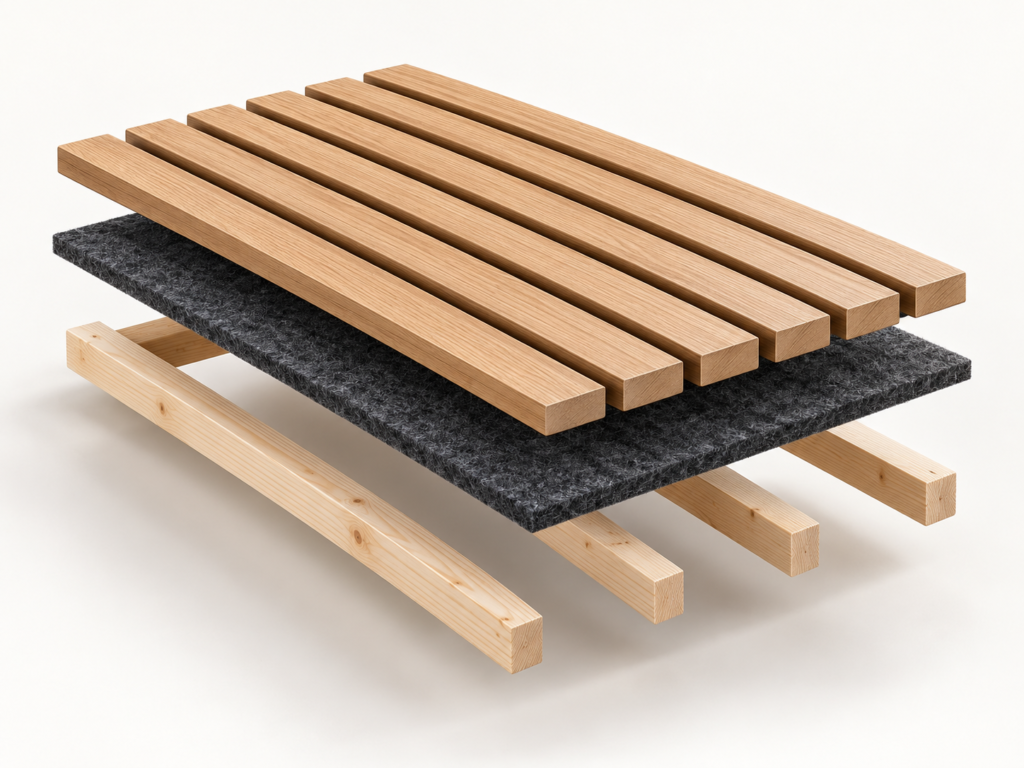
- 01Decorative finish — veneer, paint or laminate as specified
- 02MDF slats — processed panel material
- 03PET acoustic felt — porous absorption layer
- 04Optional battens & air cavity — only where specified
B. Perforated MDF Panel
Perforations provide a path through the facing into the backing assembly. Acoustic fleece, a cavity and any additional absorber must be selected as part of the model-specific system; backing is not always directly bonded to the board.
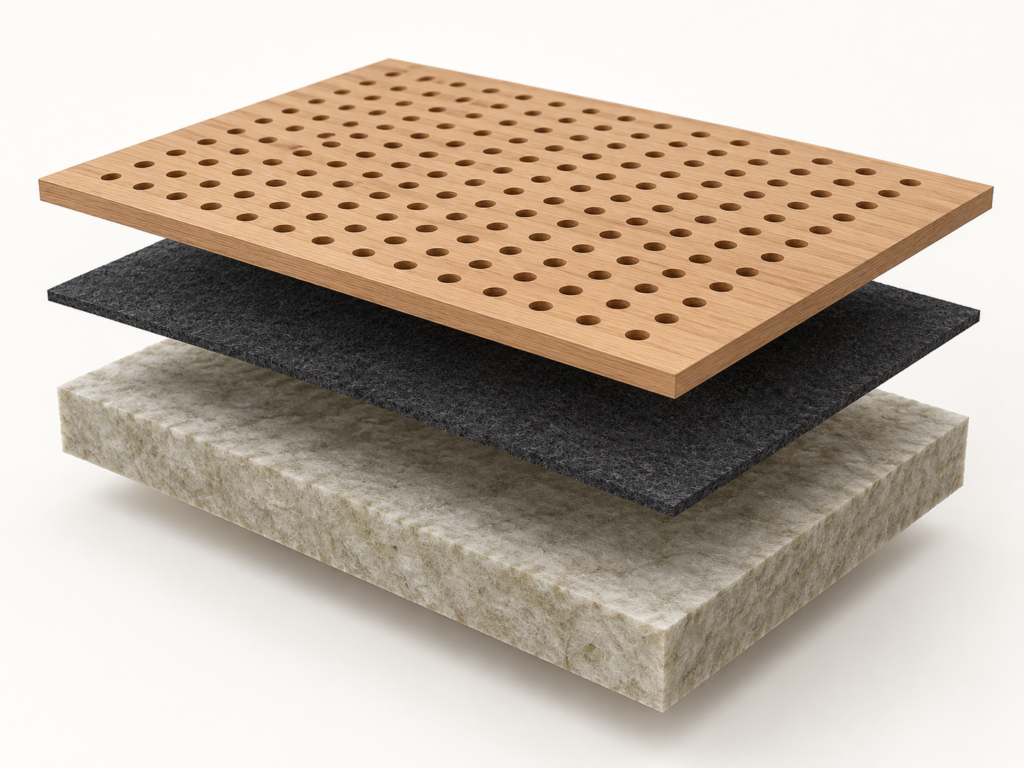
- 01Veneer or coating — compatible decorative finish
- 02Perforated MDF board — processed facing
- 03Acoustic fleece — as specified
- 04Air cavity / additional absorber — where specified
C. Grooved MDF Panel
Front grooves work with rear slots or perforations and a specified backing assembly. The pattern, open area, cavity and absorber all influence performance; confirm the actual profile drawing and test configuration.
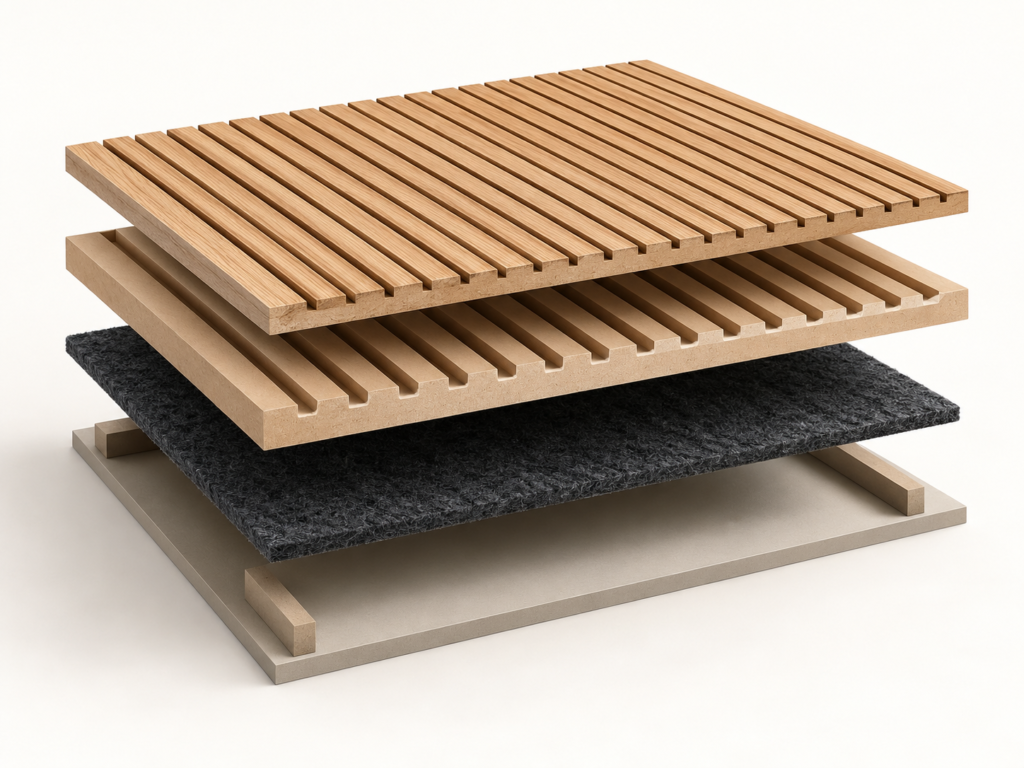
- 01Front grooves — model-specific surface pattern
- 02MDF core — processed panel material
- 03Rear slots or perforations — sound path where designed
- 04Acoustic fleece & designed cavity — absorber where specified
Key Materials and Their Roles
| Material | Role and Confirmation |
|---|---|
| MDF | Processed facing or slat material providing panel shape and dimensional support; not a load-bearing building component. |
| PET felt / acoustic fleece | Porous acoustic layer where specified. Confirm material, thickness and position; attachment and backing arrangements are model-specific. |
| Air cavity / mineral wool where specified | The cavity and any additional absorber can affect frequency-dependent absorption. Do not add or substitute layers without checking the specified and tested assembly. |
| Battens / clips / fasteners | Support and secure the installed assembly. Confirm compatibility, spacing and mounting details in the model-specific instructions. |
How Surface Structure Affects Acoustics
Perforation size, open area, groove geometry, panel thickness, backing and cavity work together. No single pattern dimension establishes absorption performance, and larger holes do not universally mean broader absorption. Use frequency-dependent test data for the complete proposed assembly.
What Determines Acoustic Performance?
Acoustic performance depends on the surface pattern, panel construction, backing and installation arrangement working together. Use test data for the complete assembly rather than a general claim about MDF or one surface pattern.
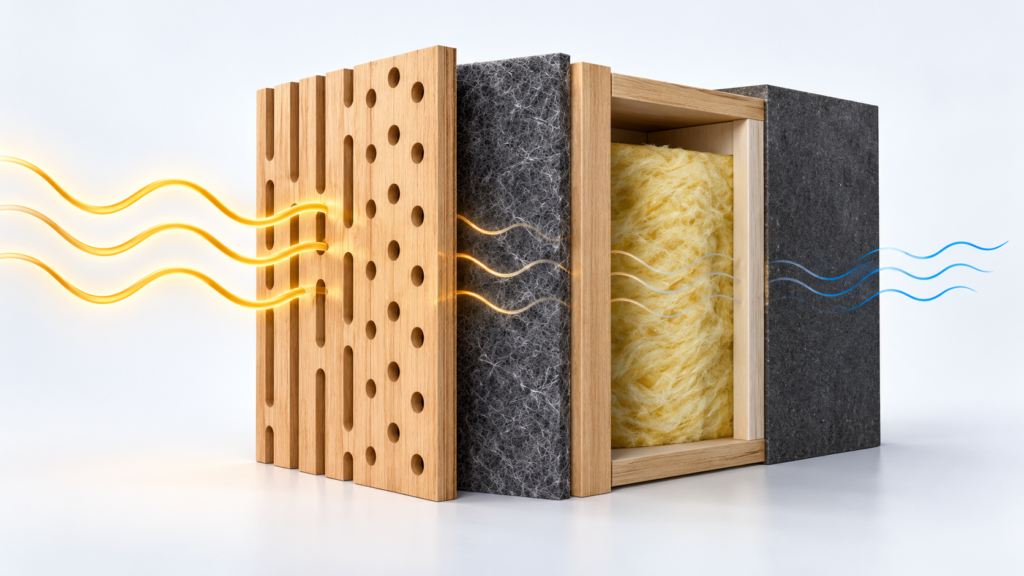
Conceptual explanation only—not a product cross-section, test result or sound-insulation guarantee.
Surface Pattern & Open Area
Opening size, spacing and open area interact with the rest of the assembly; larger holes do not universally mean broader absorption.
Panel Thickness & Density
Confirm the thickness and material specification of the tested panel. Do not transfer results between different constructions.
PET Felt or Acoustic Fleece
Confirm backing type, thickness, density and position against the product drawing and test report.
Air Cavity Depth
Cavity depth is part of the mounting configuration and can change frequency-dependent performance.
Additional Absorber Where Specified
Mineral wool or another absorber must match the specified assembly. Do not assume an added layer guarantees a particular result.
Installation & Edge Conditions
Mounting method, panel spacing, edge treatment and sealing must match the documented configuration.
Performance Claims: What to Verify
| Item | What to Verify |
|---|---|
| Sound absorption | Complete tested assembly, report reference, test method and frequency-dependent results. |
| Fire performance | Exact panel, finish, backing and mounting scope covered by the report; project-specific requirements. |
| Formaldehyde emissions | Applicable MDF grade, product scope, test method and report. A core-board result is not automatically a result for every finished assembly. |
| Moisture suitability | Model-specific indoor environmental limits and substrate moisture requirements. |
| Finish durability | Finish-specific documentation, cleaning instructions and relevant limitations. |
Use Limits
- Interior applications. This guide covers indoor MDF-based acoustic panels, not exterior systems.
- Avoid direct water exposure. Do not assume suitability for wet areas or high-moisture conditions; confirm explicit model approval.
- Control substrate and room moisture. Follow the product’s environmental limits and avoid prolonged dampness.
- Confirm project requirements. Check fire and emission documentation for the actual products and intended installation.
Selecting the Right MDF Acoustic Panel

Meeting Rooms & Offices
Prioritize the room’s speech-clarity and reverberation targets, practical finishes and the tested mounting arrangement.

Classrooms & Lecture Halls
Specify documented absorption performance, suitable coverage and durable surfaces against the project’s acoustic brief.

Hospitality Interiors
Balance acoustic control with finish, cleaning and maintenance needs. Confirm environmental and fire requirements.
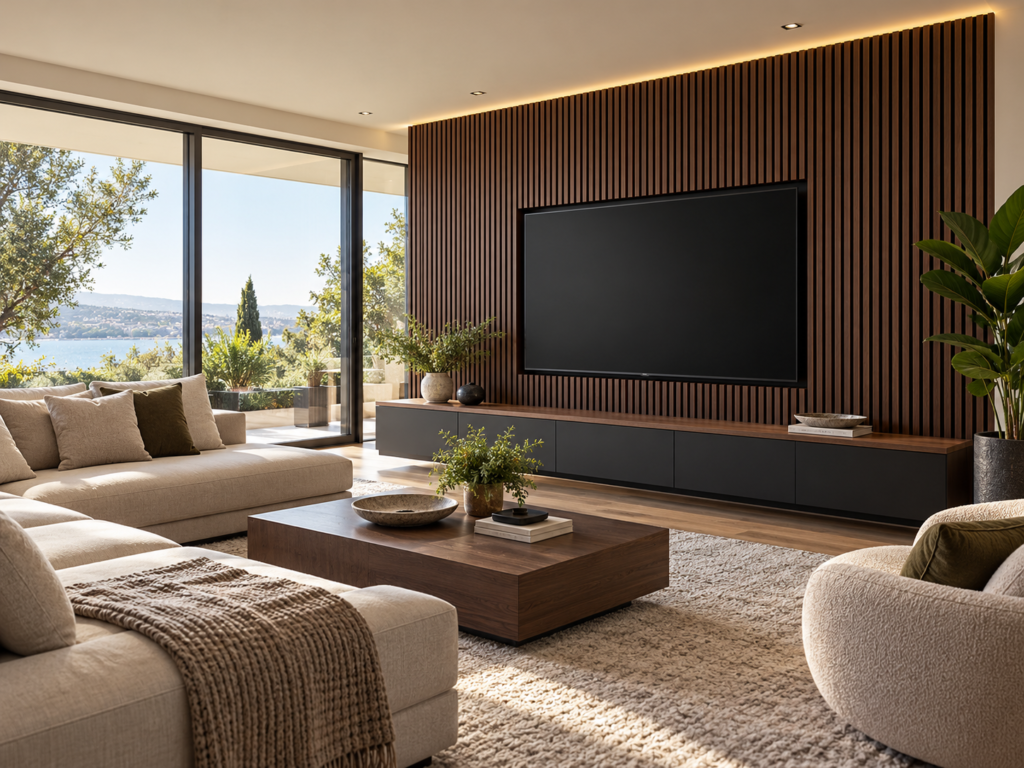
Residential Media & Living Spaces
Select the panel pattern and assembly for the room’s use and acoustic goals. Absorption alone is not a sound-isolation solution.
Documents Buyers Should Request
- Panel dimensions and profile drawings
- MDF grade and finish options
- PET felt or acoustic fleece specification
- Applicable acoustic test report and mounting configuration
- Applicable fire and emission documents
- Installation and maintenance instructions
- Packing, MOQ and production lead time